Projects
A collection of side projects, experiments, and shipped products across AI/ML, web, and mobile.
Sep 2023
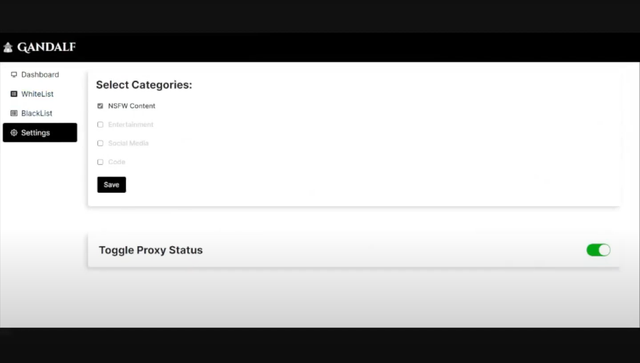
The Internet has become an essential part of one’s daily life, offering vast amounts of information at one’s fingertips. However, it also presents a significant threat to young web users who may encounter inappropriate or harmful content. To address this issue, a deep learning model, named the “Gandalf Model”, is proposed for accurately identifying the type of content on a website. The Gandalf Model uses a DistilBERT Transformer and BiLSTM to classify websites into ten categories, including NSFW. The model has been trained on a large dataset of over 400,000 data entries, which has been curated and labeled for this purpose. The experimental results demonstrate that the model achieves an accuracy of 80.1%, which is better than many traditional models used in this field. The model protects young web users from inappropriate or harmful content on the Internet thus contributing to the development of effective content filtering and blocking systems. By coupling this model with a proxy server, access to websites belonging to categories as desired by the system administrators is also successfully blocked.
Jun 2023
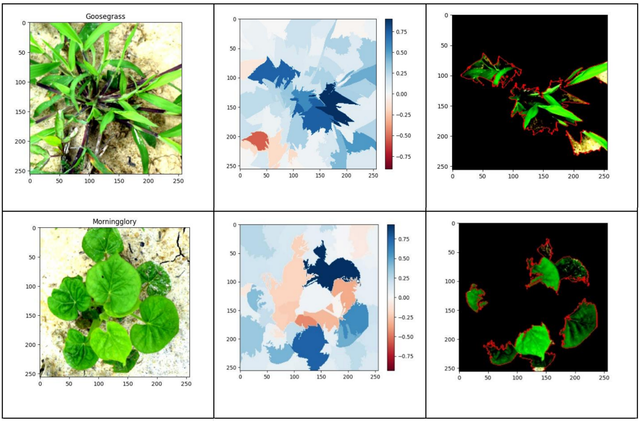
The main focus of this research project is to develop an explainable AI-based deep learning framework for revealing and categorizing of crop weeds in cotton plants. Weed revealing and categorizing is an essential task in precision agriculture as it enables farmers to apply herbicides selectively, reducing the amount of chemicals used and thus minimizing the influence on the atmosphere and human wellbeing. This framework is designed using image pre-processing techniques to crop relevant structures from the images, a deep neural network RepVggPlus to classify the presence of weeds, and finally explainable AI using LIME to elaborate on predicting why these particular results are shown. Compared to existing techniques, our proposed approach offers several advantages such as it can reveal and categorize multiple weed species simultaneously, which is not possible with most existing methods; moreover, our system provides explainable results, allowing farmers to understand how the decision was made and increasing their trust in the system. The outcome is a model that can be used as a tool that can assist farmers and agricultural workers in identifying and removing weeds, leading to increased crop yields and reduced use of herbicides. The framework designed is validated and tested on various different crop fields, to increase its generalization power, and to make sure it will work under different lighting conditions, angles of view and image resolution. This framework uses RepVggPlus which is compared with other deep learning models and proves to be better in terms of accuracy and prediction rate.
Nov 2022
This project delves into a comparative analysis of various neural network types employed in Intrusion Detection Systems (IDS). With the goal of enhancing network security and identifying potential threats, we explore the effectiveness of different neural network architectures. In this study, we have conducted a comprehensive comparison among three primary neural network types for intrusion detection: Shallow Neural Network, Deep Neural Network and Convolutional Neural Network.
Aug 2022
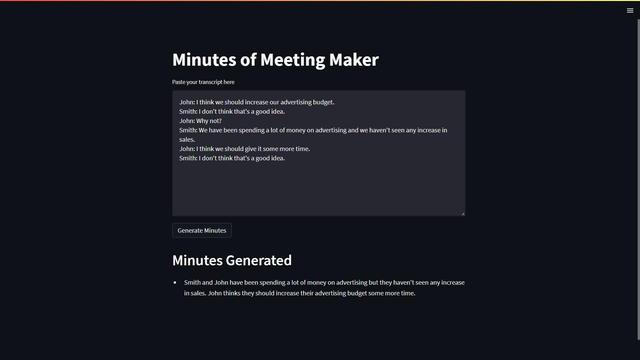
MOM Bot is a Discord bot that utilizes the T5 Transformer to simplify the process of creating Meeting Minutes (MOM) from the transcript of a meeting. Meeting minutes are essential for documenting discussions, decisions, and action items, but creating them manually can be time-consuming and tedious. This innovative bot automates the generation of MOM by extracting key insights and content from the meeting transcript. By employing state-of-the-art Natural Language Processing (NLP) technologies, it ensures that valuable information is captured accurately and efficiently.
Oct 2021
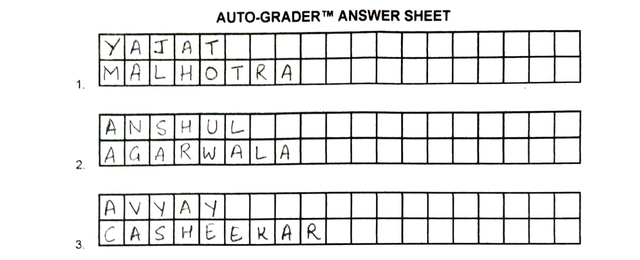
Auto Grader is a cutting-edge solution that streamlines the grading process by leveraging a deep learning pipeline. This innovative project automates the evaluation of answer sheets, making use of Computer Vision (CV) and Optical Character Recognition (OCR) to read and extract answers. It then employs BERT embeddings for similarity analysis, allowing for efficient and objective grading. It significantly reduces the time and effort required for manual grading while ensuring accuracy and consistency in the evaluation process. By combining CV, NLP, Tensorflow, FastAPI, and Docker, this project offers a versatile and robust solution for educators and institutions.
Apr 2021
An API which can classify website URLs into 10 different categories. The API was made using FastAPI (deployed on Azure) and the model was made in Tensorflow using DistilBert Transformer from Hugging Face.