Projects
A collection of side projects, experiments, and shipped products across AI/ML, web, and mobile.
Sep 2023
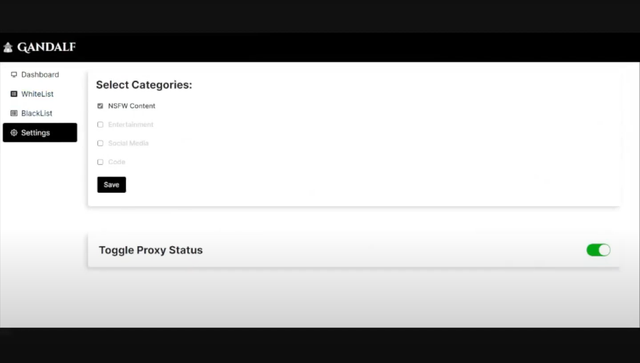
The Internet has become an essential part of one’s daily life, offering vast amounts of information at one’s fingertips. However, it also presents a significant threat to young web users who may encounter inappropriate or harmful content. To address this issue, a deep learning model, named the “Gandalf Model”, is proposed for accurately identifying the type of content on a website. The Gandalf Model uses a DistilBERT Transformer and BiLSTM to classify websites into ten categories, including NSFW. The model has been trained on a large dataset of over 400,000 data entries, which has been curated and labeled for this purpose. The experimental results demonstrate that the model achieves an accuracy of 80.1%, which is better than many traditional models used in this field. The model protects young web users from inappropriate or harmful content on the Internet thus contributing to the development of effective content filtering and blocking systems. By coupling this model with a proxy server, access to websites belonging to categories as desired by the system administrators is also successfully blocked.
Nov 2022
This project delves into a comparative analysis of various neural network types employed in Intrusion Detection Systems (IDS). With the goal of enhancing network security and identifying potential threats, we explore the effectiveness of different neural network architectures. In this study, we have conducted a comprehensive comparison among three primary neural network types for intrusion detection: Shallow Neural Network, Deep Neural Network and Convolutional Neural Network.
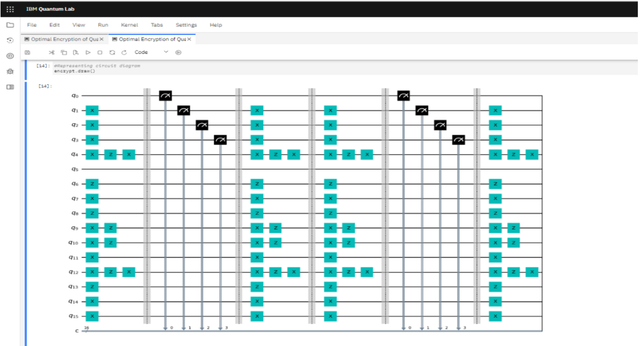
Attacks against the cryptographic algorithm are one of the many parameters that can be used in a cryptographic assault. The project focuses on how most types of conventional public key encryption are expected to be broken by quantum computing. It highlights how finding quantum-safe algorithms and practices is therefore of utmost importance. Online financial transactions and communications could be targeted by hackers with access to quantum computers if there aren't quantum-safe cryptographic safeguards in place for everything from autonomous vehicles to military hardware. This project, via various modules, focuses on the following topics in particular: current cryptographic schemes (symmetric and asymmetric), quantum computing challenges, differences between quantum and classical computing, quantum algorithms ,affected public key encryption schemes and post quantum cryptography.
Oct 2022
This project serves as a Proof of Concept (POC) application designed to implement multi-factor authentication through the unique method of keystroke analysis using n-grams. Multi-factor authentication (MFA) is a critical component of cybersecurity, enhancing the security of digital systems by requiring multiple forms of verification. In this innovative approach, the project focuses on keystroke analysis as one of the factors for authentication. It assesses the timing and rhythm of keystrokes (n-grams) to create a distinctive user profile. By analyzing keystroke patterns, the system can effectively determine the authenticity of the user, adding an extra layer of security.